
Greece rejects Turkish marine parks
Greece has described Turkey’s declaration of “national” marine parks as “invalid and lacking legal effect” insofar as they extend into areas outside Turkish jurisdiction and within the Greek continental shelf, according to a formal diplomatic demarche delivered to Ankara. The demarche was issued in response to both public Turkish statements regarding Special Spatial Planning Frameworks and presidential decisions issued on August 15, declaring two “national” marine parks.
https://www.ekathimerini.com/politics/foreign-policy/1314240/greece-rejects-turkish-marine-parks
PM says Greece won’t be told how to defend itself
Greece is a peaceful country that threatens none, but will accept nobody telling it how to defend its territory, Prime Minister Kyriakos Mitsotakis said during a meeting in Athens Thursday with European Council President Antonio Costa. His comments came amid Turkish criticism of Greece’s military procurement drive and militarization of the Aegean Sea islands, combined with a questioning of Greek sovereignty over parts of the archipelago. “I remind you that a condition for participation in the SAFE program is that the security interests of member-states should not be threatened,” Mitsotakis said, referring to the European Union’s drive to facilitate joint military procurement.
PASOK leader Androulakis sends message of political change from Crete
Main opposition PASOK leader Nikos Androulakis on Thursday sent a message of political change from Crete, while in Heraklion to mark the 52nd anniversary of the founding declaration of PASOK issued by Andreas Papandreou on 3 September 1974. Ahead of the presentation of the party’s policy positions at the Thessaloniki International Fair (TIF), Androulakis said tackling Greece’s demographic decline was an absolute priority, on a par with national security. “Today, the major issue is the demographic problem. The country is collapsing, the nation is at risk, and the demographic threat is a national threat. Defence procurement programmes are important, but the greatest instrument of national power is the population, the people. Healthy demographics,” he said.
Greece’s rental squeeze deepens as prices rise as much as 16.7%
Greece’s rental market is getting more expensive in 2026, as strong demand and a limited supply of available homes continue to push prices higher, particularly in Athens and other sought-after locations. Average residential rents nationwide rose 3.8% from 2025, according to data from RE/MAX Greece. The survey, based on rental transactions through the company’s network across 124 areas, shows that demand remains particularly strong for higher-quality properties. Attica, the region encompassing Athens and its suburbs, recorded a 4.3% increase, while rents in the rest of Greece rose 4%. Thessaloniki, the country’s second-largest city, posted a more moderate 3% increase. The figures highlight how Greece’s housing affordability problem is spreading beyond traditionally expensive neighborhoods. More than 30 of the 124 areas surveyed now command average rents of at least €10 a square meter.
ATHEX: Stock market rebounds to 17-year high
The Euronext Athens (ATHEX) general index closed at 2,691.43 points, adding 1.62% to Wednesday’s 2,648.58 points. The large-cap FTSE-25 index expanded 1.67% to end at 6,890.44 points.
https://www.ekathimerini.com/economy/1314246/athex-stock-market-rebounds-to-17-year-high


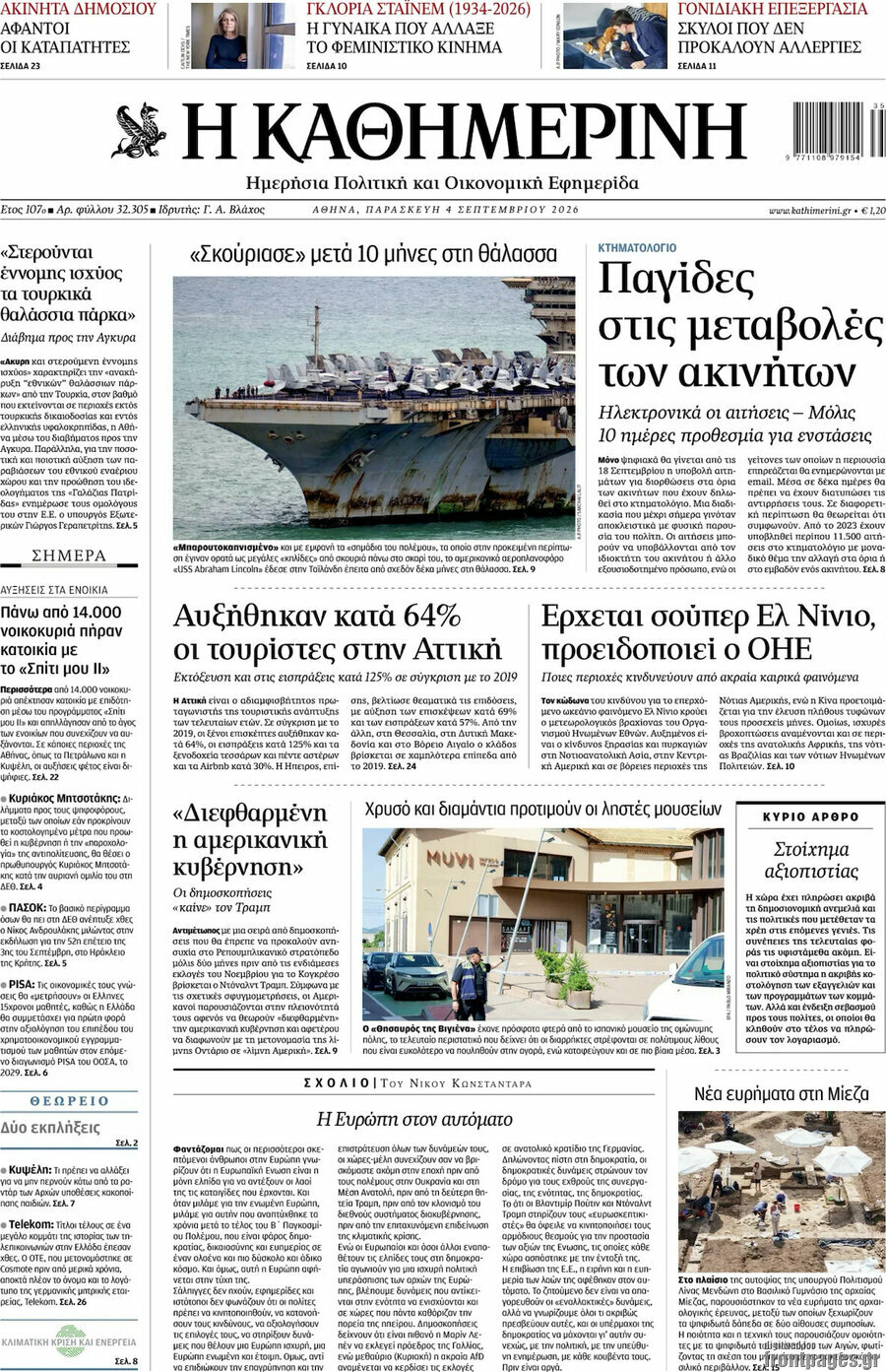
KATHIMERINI: Traps in the declaration of changes linked to real estate assets
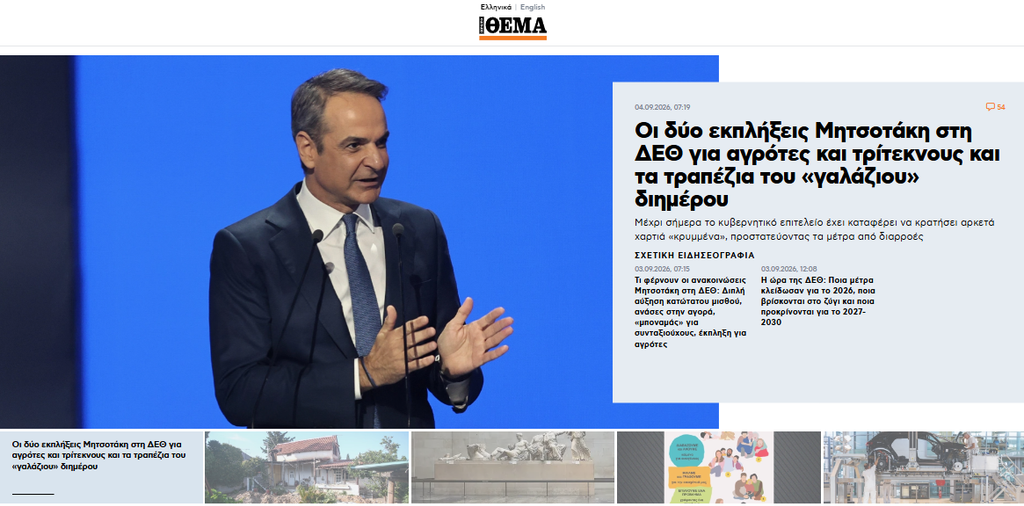
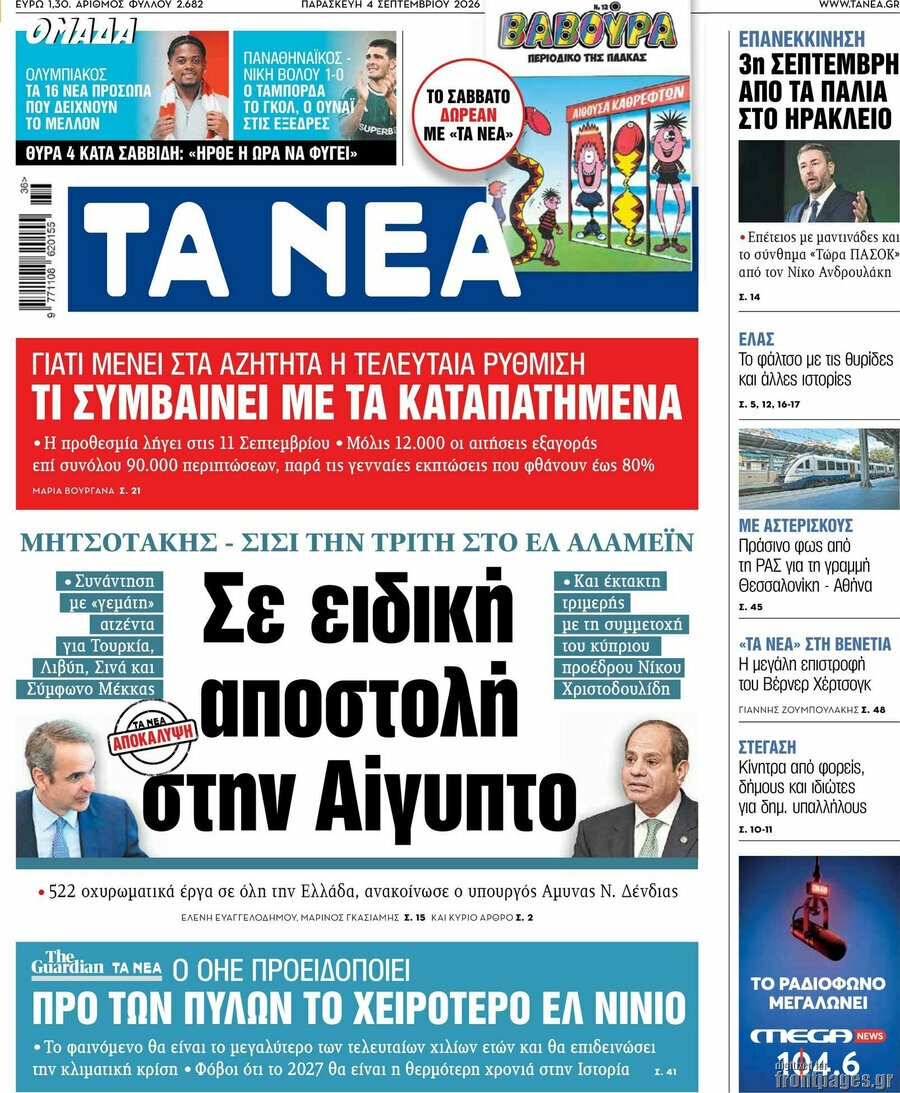
TA NEA: Mitsotakis-Sisi: Special mission in Egypt
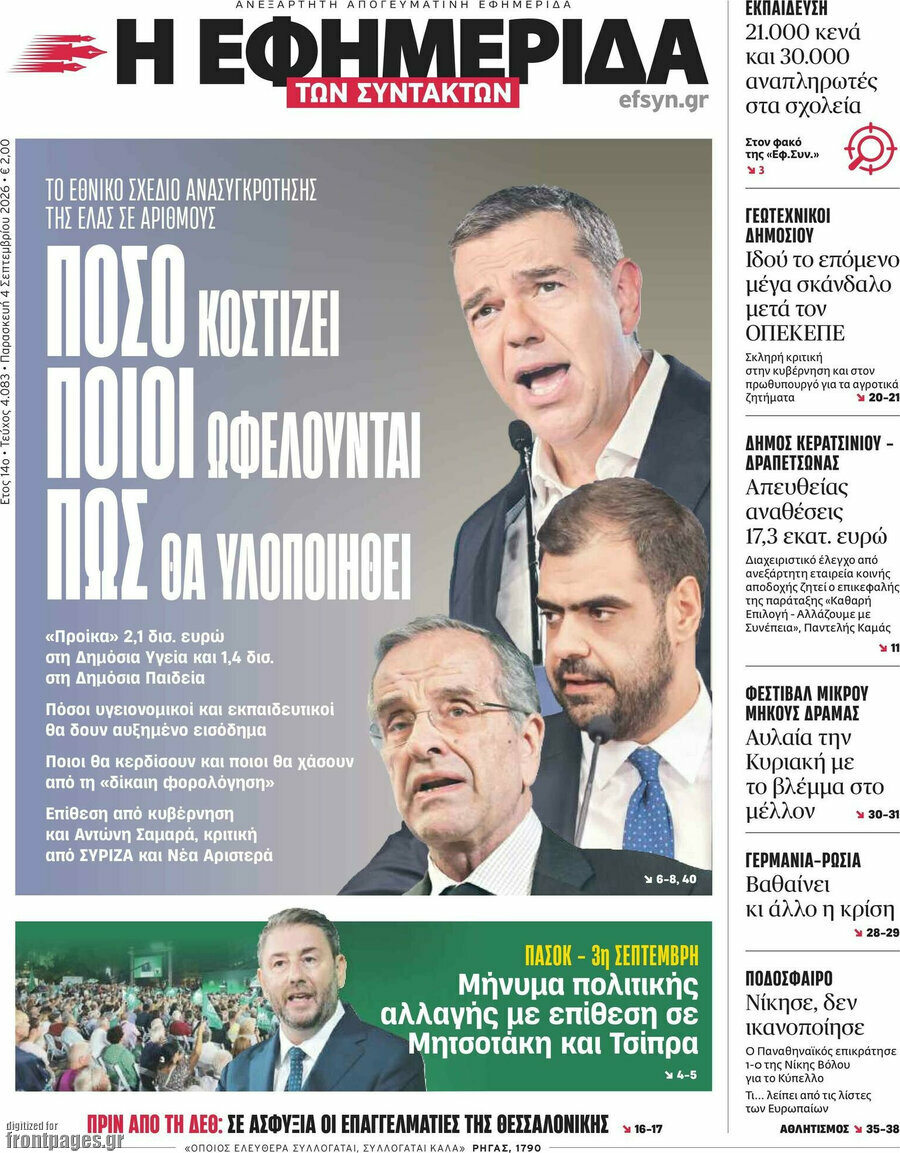
EFIMERIDA TON SYNTAKTON: ELAS economic program: How much does it cost, who will benefit and how it will be implemented
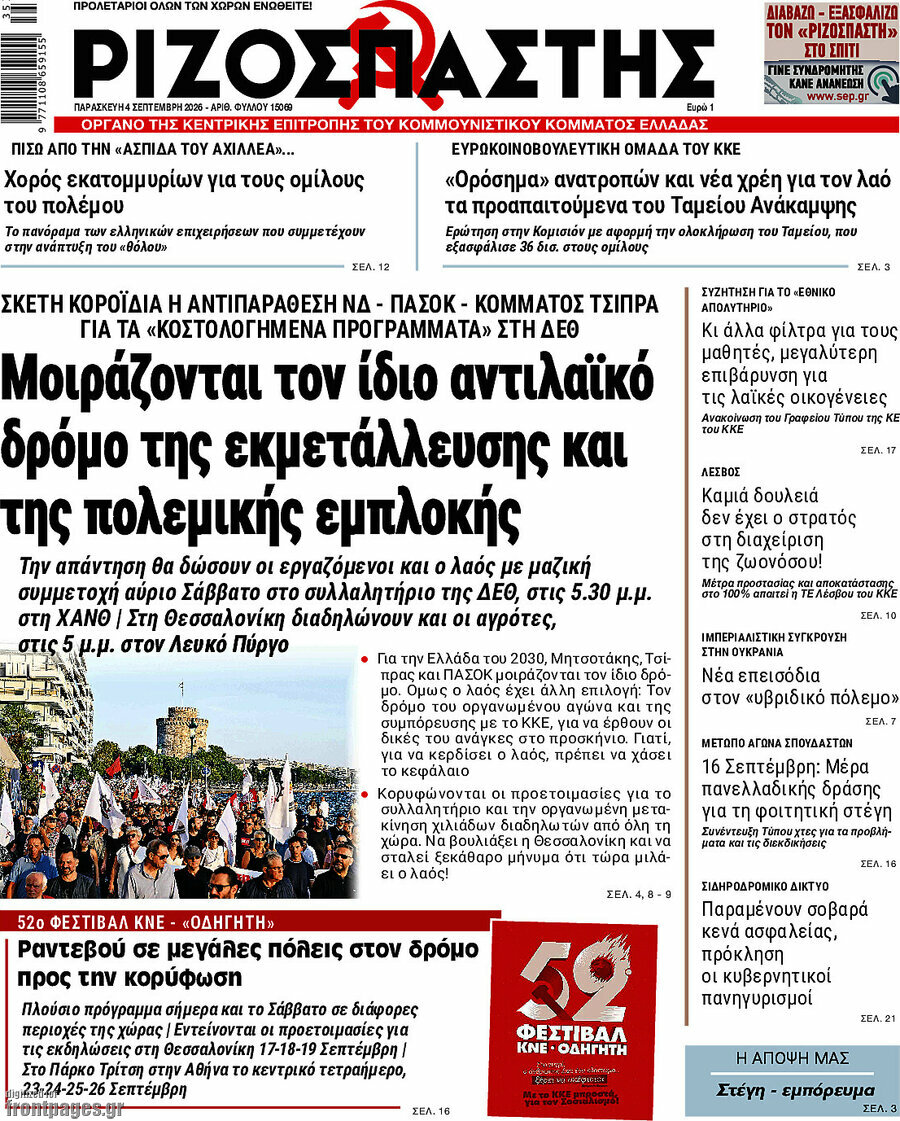
RIZOSPASTIS: New Democracy, PASOK and ELAS share the same antipopular plans for workers and war involvement
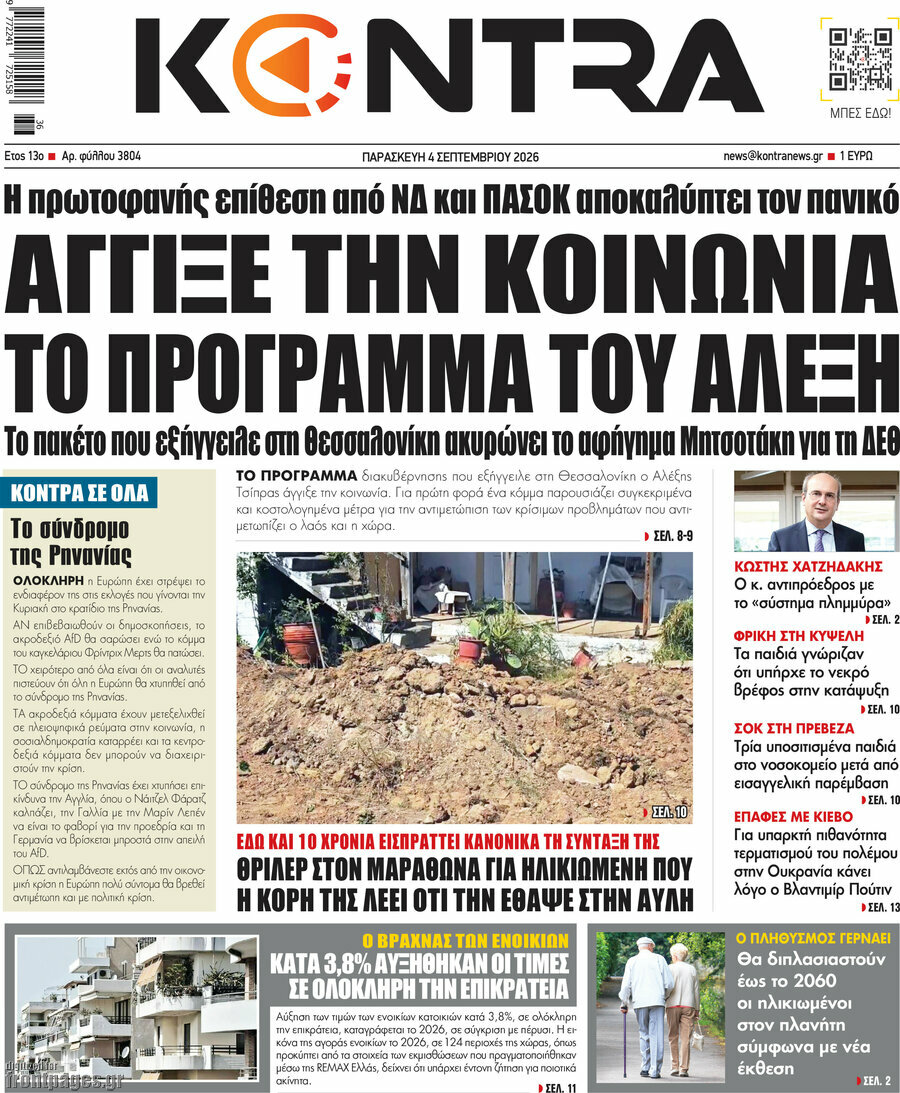
KONTRA NEWS: Alexis’ economic program “touched” Greek society
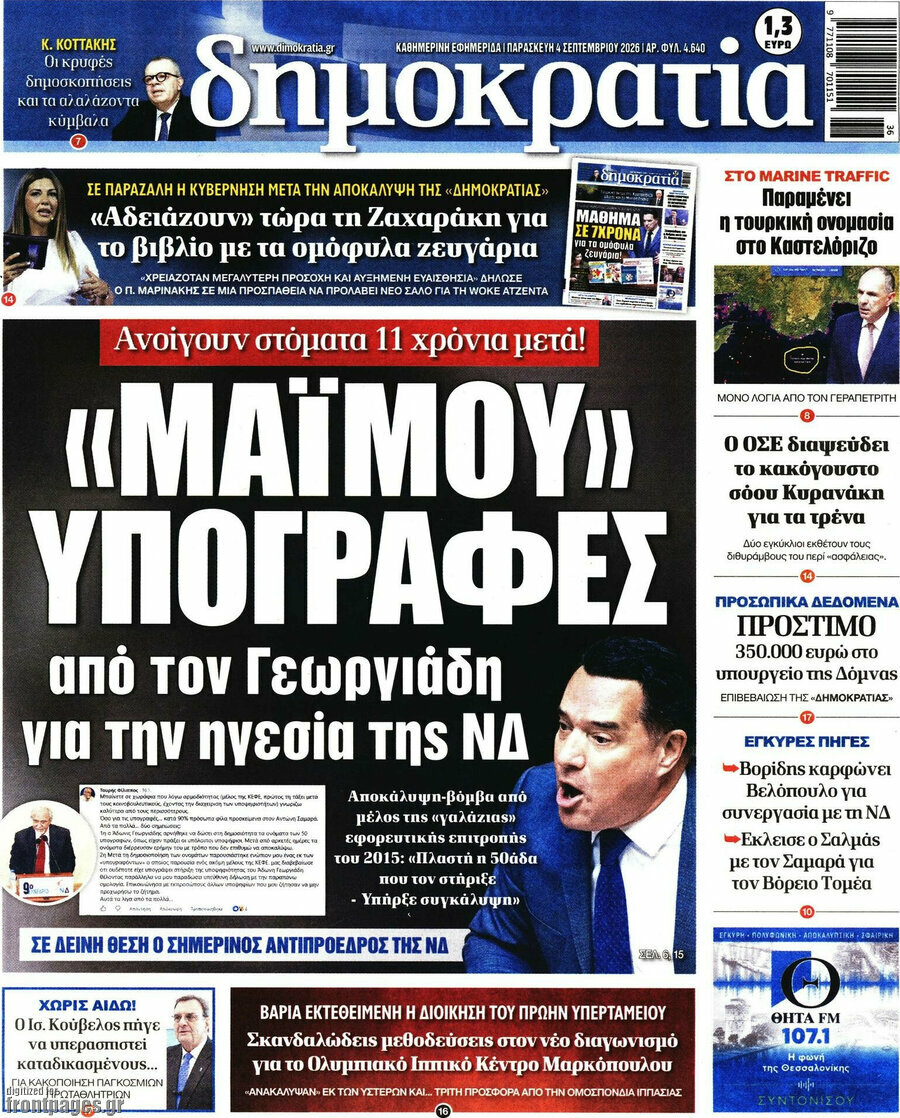
DIMOKRATIA: Fake signatures of support were submitted by Georgiadis during his claim of New Democracy’s leadership
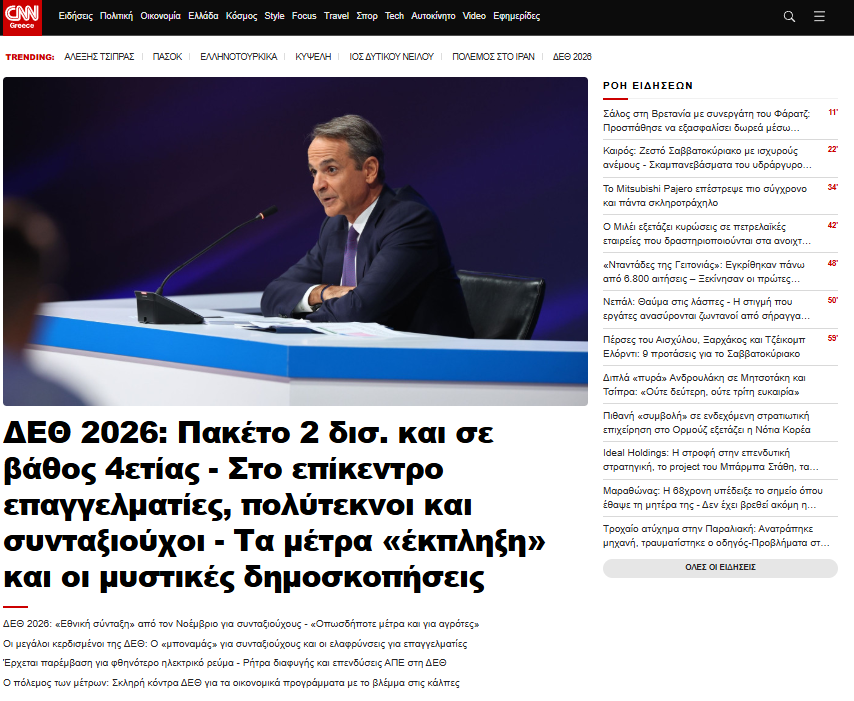
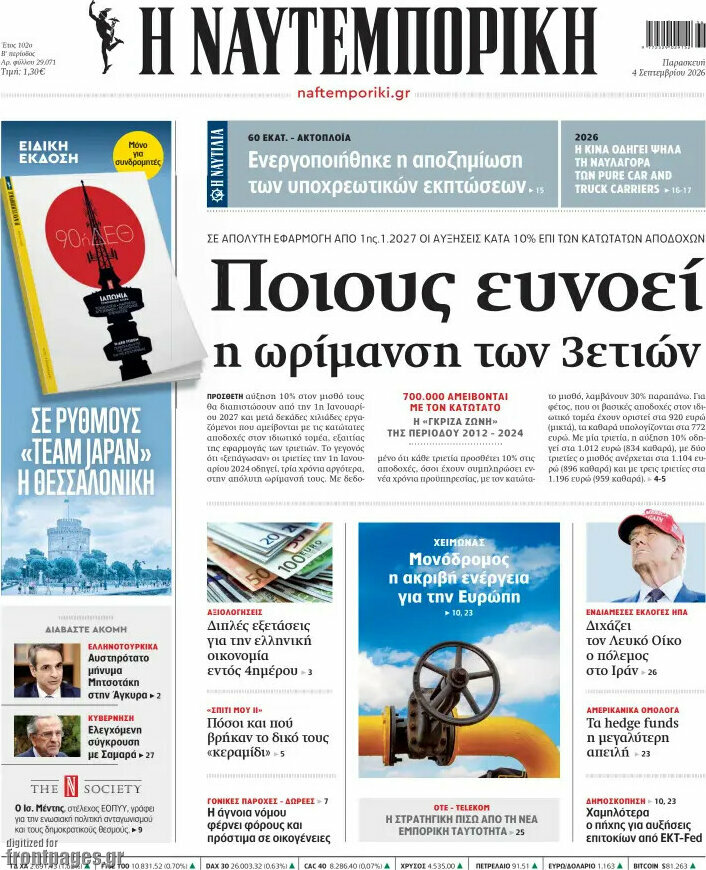
NAFTEMPORIKI: Who benefits from 3-year salary increases

DRIVING THE DAY
BIGGER, FASTER: EU countries will today tell the Commission to speed up work that would make it easier for new members to join the bloc, warning that the bruising referendum defeat in Iceland should be a wake-up call for enlargement policy.
European affairs ministers and representatives from candidate and potential candidate countries — including Ukraine, Montenegro, Bosnia, North Macedonia, Moldova and Kosovo — will meet today in Dublin for the first major discussion in months on how to break the deadlock and get them into the EU.
Despite broad support for enlargement, EU capitals led by Berlin, Paris and The Hague are worried that admitting them too quickly could cause problems without rules in place to prevent a new member from turning into a troublemaker. It’s the Commission’s job to draft those rules — and until it finds a solution, the entire process is mired in uncertainty. Ideas such as reverse enlargement have been shot down by capitals.
High stakes: Iceland’s decision not to restart membership talks “doesn’t help the idea that the EU is a club that lots of people want to be part of,” Austria’s Europe Minister Claudia Bauer told Playbook. Not admitting those who do want to join, she said, would have “an impact on our credibility” and create a vacuum for “foreign influences, the influences of Russia, of the United States, of China.”
The solution, Bauer said, is to design “safeguards that protect the Union without turning accession into a permanent obstacle course.”
Tell us what you think: Enlargement Commissioner Marta Kos, who will take part in today’s meeting, has declared this will be an “autumn of enlargement.” She’s working up proposals to strip new members of their rights if they break the bloc’s rules or disrupt key policies, but is keeping quiet on what these plans might look like. Ireland’s Europe Minister Thomas Byrne, who will chair the talks in Dublin, said the plan is expected “towards the end of the month,” and today will be a chance to agree what needs to be in it.
Candidate countries are getting restless. “Our government is working full speed,” said Moldova’s European Integration Minister Cristina Gherasimov, who will attend the talks. “What we need is for the member states to meet us halfway … the way the EU can help us now is to move [forward] with the political decisions necessary.”
Hearts and minds: Bauer also wants the EU to “improve communications on enlargement because there are still skeptical countries and especially skeptical citizens.”
Supporters of Germany’s far-right Alternative for Germany are particularly skeptical. In a poll conducted by Public First for POLITICO in June, only one-third of German respondents said Ukraine should never become a member of the EU. But among those who said they intended to cast their vote for the AfD in the next national election, that share shot up to 65 percent. It’s a strong signal for the EU ahead of this weekend’s pivotal election in the eastern state of Saxony-Anhalt, which the AfD looks set to win.
 |
BIG AND BREAKING
ALL EYES ON EASTERN GERMANY: Friedrich Merz and his fragile coalition face political humiliation in Saxony-Anhalt even if the AfD doesn’t win enough votes to secure an outright parliamentary majority and govern the state alone, my colleagues Nette Nöstlinger and James Angelos write.
Did the firewall fail? The long-standing policy of mainstream parties refusing to work with the AfD could have helped rather than hindered its route to power, Marc Felix Serrao reports.
Brussels on edge: The prospect of a decisive AfD victory should spur EU capitals to negotiate a compromise on the bloc’s long-term budget before a string of elections next year could hand more power to Euroskeptics, diplomats told me and Zoya Sheftalovich.
SCOOP — O CANADA: Canadian trade chief Maninder Sidhu has been invited to join EU trade talks in Dublin next month as Brussels and Ottawa push for closer ties, POLITICO reports.
AIR DEFENSE CRISIS: Ukraine is facing a major shortfall of interceptor rockets as Russia steps up missile attacks on civilians and infrastructure, Victor Jack and Jacopo Barigazzi write this morning.
ONE-WAY TICKET: Denmark, Germany, the Netherlands, Austria and Greece are expected to agree on the next steps to begin deporting failed migrants to “return hubs” in countries outside the EU when they meet in Copenhagen today, a Danish official told Playbook.
BUDGET BATTLE HEATS UP
SERAFIN — BUDGET CUTS COULD BACKFIRE: EU Budget Commissioner Piotr Serafin fears that reductions to the bloc’s next long-term budget would hit the very areas Brussels most wants to strengthen: competitiveness, defense and security. Those top priorities could “become the first victims of cuts,” Serafin told reporters at the informal General Affairs Council yesterday.
Sounding the alarm: Serafin said the Commission’s role in the negotiations now is to point out the consequences of drastic cuts to its nearly €2 trillion proposal for the 2028-2034 budget. Asked what those consequences would be, he told Playbook’s Zoya Sheftalovich: “Less security, less competitiveness.”
Nobody’s baby: If the budget shrinks significantly, Serafin said national governments would likely defend their pet budget topics, such as agriculture and cohesion funding. “I’m not sure who’s going to put competitiveness and security as his or her red line,” he said.
Proving the point: Spain’s Europe Minister Fernando Sampedro said his country opposes any reductions to the Commission’s budget proposal, and wants to protect the ambition for cohesion, agriculture and fisheries. Security and defense are priorities, Sampedro said when pressed by Zoya — but not “at the expense of all other key priorities,” particularly climate change.
Serafin said he is still optimistic about the negotiations, arguing that growing tensions over the size of the Commission’s proposal showed that capitals were finally taking it seriously. “The worst thing for those MFF negotiations is when people take it lightly and don’t engage,” he said. Now, “we are in business.”
Frugals engage: Germany’s Europe Minister Gunther Krichbaum said Berlin’s own budget constraints, weak growth and pressure on its export-heavy industry, including from China and Donald Trump’s tariffs, made the Commission’s proposal a no-go. “We are suffering,” Krichbaum said. “We have to look what is realistic or not of this. The proposal of the European Commission is not realistic.”
20-SECOND PLAYBOOK PRIMER
With Europe paying close attention to the election in Saxony-Anhalt on Sunday, it’s worth asking: What powers do these states have? Quite a lot. The German constitution says the Länder (the states) have the right to legislate unless otherwise stated in the constitution itself. That means the list of regional powers is long and includes education, health care and policing. That said, the constitution makes it clear that “Federal law shall take precedence over Land law.”
PARLIAMENT UNITED?
NO ONE ON THE RIGHT WING: The European Parliament is getting a football team — but far-right lawmakers won’t be allowed to join, according to its founder.
German Renew MEP Lukas Sieper — known for his influencer-style videos on social media — is setting up the team to take on national parliaments from across Europe. There will be a couple of trials to pick the players, but no training sessions, since MEPs’ schedules are simply too full, Sieper told Playbook. Check out its planned logo here.
The first match will be against FC Bundestag, with the “big goal” (pun intended) being to play in the International Parliamentary Football Tournament, which features teams from the German, Finnish, Austrian and Swiss parliaments.
Cordon sanitaire: The team won’t be officially affiliated with the Parliament or receive any funding. MEPs will pay their own way. It will be mixed-gender and players will have to “support the principles of democracy, the rule of law and European integration” to be admitted, according to its draft statutes.
Sieper said it’s “unimaginable” that a member of the far-right Patriots for Europe or Europe of Sovereign Nations groups could meet the criteria, although such decisions will be made on a case-by-case basis by the club board.
HARASSMENT COMPLAINTS: Two MEPs are pressing the European Commission over reports of verbal and physical harassment inside the institution, after a POLITICO investigation revealed almost 1,000 requests had been made to its confidential counsellors since 2024.
ECR MEPs Sander Smit and Jessika van Leeuwen want to know what “concrete measures” the Commission is taking against abuses of power, whether it will publish data on complaints and whether the allegations could damage public trust in the EU.
7 MORE THINGS GETTING US TALKING
MELONI’S MILESTONE: Giorgia Meloni today overtakes Silvio Berlusconi’s record for the longest unbroken stretch as Italian leader since the republic was founded — and she’ll celebrate this evening with a Brothers of Italy rally in Bari.
TROUBLE IN PARADISE: France’s far-right leaders Marine Le Pen and Jordan Bardella are increasingly at odds over key policies like a proposed hijab ban and internal politics, Marion Solletty writes.
ONE TO WATCH TODAY: Bardella will be the star guest at Nigel Farage’s Reform UK party conference in Birmingham.
FARAGE’S WISHLIST: Farage will want to thrash out new arrangements with the EU in several key areas if he becomes Britain’s next prime minister, including fishing, migration controls and student loans.
BIG GOAL: Ukraine and Poland are contemplating a joint bid to host the men’s FIFA World Cup in the 2040s, Martina Sapio scoops.
UNDOING ORBÁN: Hungary’s new government wants back into the EU’s science and research programs as Péter Magyar tries to heal the rift with Brussels.
NO LOVE LOST: FIFA has accused UEFA of pursuing a “smear campaign” against Gianni Infantino as the spat between the footballing bodies over the failed World Cup privatization plan spills into the U.S. courts, Sky News reports.